Pediatrician FAQs — Kids Food, Cereal & Nutrition
Reviewed by Dr. Sayed Mujahid Husain, MBBS, DNB-Paediatrics — Consultant Pediatrician, 14 years.
Last updated: 29 May 2026
This is our pediatrician FAQ — 20 of the questions parents most often ask, answered by Dr. Sayed Mujahid Husain. Each question has a tight direct answer first, then a more detailed explanation if you want to read further. Skip to the section you need.
Jump to: About Hungry Koala · When can my child start solids? · Ragi, millet, oats explained · Sugar, weight, worry questions
About Hungry Koala
Trust, founder story, manufacturing, and safety.
Who is the founder of Hungry Koala?
Direct answer: Hungry Koala was founded in 2022 by Dr. Sayed Mujahid Husain — a Bengaluru-based pediatrician with 14 years of clinical practice — and his wife Shazia Anjum. They built the brand after struggling to find clean, honest food for their own child.
Detail. Dr. Sayed Mujahid Husain holds an MBBS and DNB-Paediatrics from MS Ramaiah Medical College. He is Consultant Pediatrician at Goodwill Children's Clinic, HSR Layout, Bengaluru. Shazia runs the brand operations — sourcing, manufacturing, and team. Every product is built by Dr. Husain (ingredient, ratio, age-appropriateness) before it is tested or sold. Their first product was a sprouted moong dal cereal made for their own son. By 2022, Hungry Koala was a real brand selling to families across India.
Is Hungry Koala food safe for my child?
Direct answer: Yes. Every Hungry Koala product is formulated by Dr. Sayed Mujahid Husain, a practicing pediatrician with 14 years of experience, and is FSSAI-approved. Products are designed for specific age stages, contain no refined sugar, no maltodextrin, and no preservatives. Our Cereyum range (sprouted cereals) contains no added sugar at all.
Detail. Hungry Koala is manufactured in our own facility in Bengaluru — we don't use third-party manufacturers. Every batch is hand-checked by our team. Products are designed by age — Cereyum starts at 6 months, Whole Grain Pancakes are for 2 years+, and Hungry Koala Wholgro SuperKids is for 2 years+. Every ingredient is selected by a pediatrician for nutritional adequacy and digestive gentleness. No artificial preservatives, colours, flavours, or hydrogenated fats. No maida. No palm oil. India Organic certified.
Where is Hungry Koala made?
Direct answer: Hungry Koala is 100% in-house manufactured in our own facility in Bengaluru, India. We don't use third-party manufacturers — we control every step from sourcing the grain to packing the final product.
Detail. Our facility is in Bettadasanapura, Bangalore (560105). Owning manufacturing lets us decide exactly what goes in — and what doesn't. We source grains from ethical farmers using organic methods, sprout them on-site, mill at low temperatures to preserve nutrients, and pack without preservatives. This is also why our shelf-life is shorter than mass-market brands — clean food doesn't last as long, but it's fresher.
Is Dr. Sayed Mujahid Husain a real pediatrician?
Direct answer: Yes. Dr. Sayed Mujahid Husain holds an MBBS and DNB-Paediatrics from MS Ramaiah Medical College. He has 14 years of clinical experience and is currently Consultant Pediatrician at Goodwill Children's Clinic, HSR Layout, Bengaluru. His Practo, Lybrate, MyUpchar, DocIndia and Drlogy profiles are all publicly verifiable.
Detail. Dr. Husain has 14 years of clinical experience, over 10 of those as a specialist. His clinical focus is newborn care, infant nutrition, growth and development monitoring, and pediatric immunology. He sees patients regularly at his clinic — Hungry Koala is not a celebrity-endorsement brand. He is a working pediatrician who designs the products himself.
What are the side effects of Hungry Koala products?
Direct answer: There are no known side effects when used as directed. Hungry Koala is FSSAI-approved, formulated by Dr. Sayed Mujahid Husain (pediatrician, 14 years), and contains no refined sugar, no maltodextrin, no preservatives. Introduce any new food gradually to check for individual allergies.
Detail. Standard pediatric advice when introducing any new food to a child is the "three-day rule" — give a small portion of one new food for three consecutive days and watch for any reaction (rash, digestive upset, fussiness). This applies to Hungry Koala the same way it applies to any new food. If your child has a known allergy to any of our listed ingredients (e.g. moong dal, oats), consult your pediatrician before introducing.
When can my child start solids?
Age-stage guidance — when to start, what to give, how much.
When can my child start solid food?
Direct answer: Children can start solid foods, including cereal, at 6 months. Before 6 months, exclusive breastfeeding (or formula) is recommended by the WHO. The Indian Academy of Pediatrics (IAP) agrees — wait for signs your child is ready: holds head up, shows interest in food.
Detail. Look for these readiness signs: child can sit upright with support, shows interest in family meals, can take food off a spoon. Some children are ready slightly before 6 months and some slightly after — that's normal. Start with one feed a day, watch for tolerance, then build up. Cereyum starts at 6 months because we formulate for that stage of digestion.
What is the best first cereal for a 6-month-old in India?
Direct answer: For a 6-month-old in India, the best first cereal is single-ingredient, easily digestible, allergen-free, and free from added sugar or preservatives. Sprouted ragi, sprouted moong dal, and apple/banana purées are pediatrician-recommended starts. Hungry Koala Cereyum is built specifically for this stage.
Detail. Dr. Sayed Mujahid Husain recommends starting with single-grain or single-fruit options to make it easy to spot any allergies. Avoid commercial cereals with added sugar, maltodextrin, or refined flour at this stage. Sprouted grains (we sprout our moong, ragi, and millet) are gentler on developing digestive systems because sprouting breaks down complex sugars and proteins. Cereyum Sprouted Moong & Date and Cereyum Organic Ragi & Banana are designed exactly for this age.
What cereal is good for a 1-year-old in India?
Direct answer: For a 1-year-old in India, look for cereals with whole grains, no added sugar, and a mix of ingredients for varied nutrition. Pediatrician-built options like Hungry Koala's Cereyum range (ragi, millet, oats, moong) and Hungry Koala Wholgro SuperKids for older toddlers offer clean nutrition without maltodextrin or refined sugar.
Detail. At 1 year, your child's digestion can handle a wider variety of grains. Whole-grain oats, millets, ragi, and moong dal provide iron, calcium, and protein. Avoid cereals with refined sugar (read the back-of-pack — not the front-of-pack marketing). The key red flags: maltodextrin, refined sugar, hydrogenated fats, vague "flavours." Cereyum and Hungry Koala Wholgro SuperKids are built without any of these.
What can I feed a 7-month-old besides milk?
Direct answer: At 7 months, your child can have soft, mashed foods alongside milk — sprouted grain cereals, fruit purées (banana, apple, papaya), vegetable purées (carrot, sweet potato), well-mashed dal, and ragi or millet porridges. Aim for variety, single-ingredient introductions, and no added sugar or salt until 12 months.
Detail. Dr. Sayed Mujahid Husain recommends introducing 2–3 new foods per week at this stage, watching for tolerance using the 3-day rule. Iron-rich foods become important from 6 months — ragi, dates, leafy greens (mashed), and lentils help. Hungry Koala Cereyum's 7-month combos (e.g. Protein Rich Combo with oats, carrot, sprouted moong, dates) are formulated for this exact stage.
How much cereal should I give my child per day?
Direct answer: A 6-month-old typically takes 2–4 tablespoons of cereal per feed, 1–2 feeds per day. As your child grows, gradually increase to 4–8 tablespoons by 9 months. The IAP recommends following child's hunger and fullness cues. Watch for satiety signs: good urine output, sound sleep, and decreased crying.
Detail. Every child is different — some take more, some less. The goal isn't to hit a number; it's to provide nutrition alongside breast milk or formula. Infants need about 80–100 kcal/kg/day for growth. If your child refuses, try again the next day with a slightly different texture or temperature. "Neophobia" (refusing new foods) is normal — pediatrician advice is to keep offering, not to force.
Ragi, millet, oats — explained
Grain-by-grain breakdown of what's in Cereyum and why.
Which is better for kids: ragi, millet, or oats?
Direct answer: All three are excellent for kids — they're complementary, not competing. Ragi is highest in calcium, millet is highest in fibre, oats are highest in soluble fibre and beta-glucan. The best diet rotates them. Hungry Koala uses all three in different products so little ones get the full nutritional spectrum across the week.
Detail. Ragi (finger millet) provides about 350mg calcium per 100g — among the highest of any plant food. Little millet provides slow-release energy and is gentle on tummies. Oats provide soluble fibre (good for digestion) and beta-glucan (immune support). Dr. Sayed Mujahid Husain's recommendation: rotate, don't single-track. Cereyum's range spans all three so a week's worth of breakfasts naturally includes the full grain spectrum.
Is ragi cereal good for kids?
Direct answer: Yes — ragi (finger millet) is one of the best kids cereals available. Ragi is naturally high in calcium (about 350mg per 100g), iron, and amino acids essential for growth. It's gluten-free, easy to digest when sprouted, and is one of the traditional first foods given to Indian little ones.
Detail. Dr. Sayed Mujahid Husain recommends sprouted ragi specifically because sprouting breaks down phytic acid (which can block mineral absorption) and starts pre-digesting starches and proteins — making the nutrients more bioavailable for a young child's developing digestive system. Hungry Koala Cereyum Organic Ragi & Banana Cereal is built for 6+ months and combines ragi with natural banana powder for taste and added iron.
What is the best oats brand for kids in India?
Direct answer: The best oats brand for kids in India is one with clean ingredients, no refined sugar, no maltodextrin, no preservatives — and designed by someone who actually understands infant nutrition. Hungry Koala's oats-based products (Organic Oats & Carrot Khichdi, Hungry Koala Wholgro SuperKids drink mixes) are formulated by Dr. Sayed Mujahid Husain, a practicing pediatrician with 14 years' experience.
Detail. When comparing brands, read the back-of-pack ingredient list — not the front. Many "healthy" kids cereal brands contain maltodextrin (a sugar substitute), refined sugar, or added flavours. Hungry Koala does not. Our Organic Oats and Carrot Khichdi blends oats with carrot and moong dal for protein, fibre, and natural sweetness — no added sugar required. Hungry Koala Wholgro SuperKids (2 years+) uses ragi, sorghum (jowar), oats, barley, pea protein, almond, dates, and jaggery — a clean whole-grain blend with no refined sugar or maltodextrin.
What are millet-based cereals for kids?
Direct answer: Millet-based cereals for kids use millets — small whole grains like little millet, sorghum (jowar), bajra, or ragi — instead of refined wheat or rice. They are naturally gluten-free, higher in fibre and minerals (iron, calcium, magnesium), and considered easier to digest. Hungry Koala's Cereyum Millet & Apple is a pediatrician-formulated option for 6 months+.
Detail. India's millet revival (millet was named the International Year of Millets crop in 2023) makes these grains widely available again. For little ones, millet's slower glucose release is gentler on developing metabolism than refined cereals. Hungry Koala blends sorghum (jowar) with little millet and natural apple powder in our Cereyum Millet & Apple cereal. Combine with milk or water for a quick, clean breakfast.
Why do you sprout your grains?
Direct answer: Sprouting grains makes them easier for little ones to digest. The sprouting process breaks down phytic acid (which blocks mineral absorption), starts pre-digesting starches and proteins, and increases vitamin content. Hungry Koala sprouts moong, ragi, and millets in-house before milling — gentler on tiny tummies, more bioavailable nutrition.
Detail. Dr. Sayed Mujahid Husain explains: a young child's digestive enzymes mature gradually over the first year. Sprouted grains essentially "pre-digest" themselves, making the same nutrients available with less digestive load. Sprouting also increases B-vitamin content. Industrially, most kids cereals skip this step because it's slower and more expensive. We don't.
Sugar, weight, and the worry questions
What pediatricians actually say — anti-fear, fact-led.
Is sugar bad for kids?
Direct answer: Added refined sugar is best avoided for kids under 2 years and minimized for older kids. The World Health Organization recommends children consume less than 10% of daily calories from added sugar. Natural sugars from whole fruits, dates, and milk are fine — they come with fibre, vitamins, and minerals that refined sugar lacks.
Detail. Dr. Sayed Mujahid Husain on the sugar question: it's not "sugar vs no sugar" — it's "refined vs whole." A date contains sugar, but also fibre, iron, magnesium, and potassium. Refined sugar contains only calories. Hungry Koala uses dates, jaggery, and natural fruit powders for sweetness — never refined sugar. We also don't use maltodextrin, which behaves like sugar metabolically despite often being labelled separately.
Are dates a healthy sugar substitute for kids?
Direct answer: Yes. Dates are a whole-food sweetener with fibre, iron, magnesium, potassium, and antioxidants. Unlike refined sugar, dates release glucose slowly because of their fibre content — avoiding the sharp blood sugar spikes that refined sugar causes. Dr. Sayed Mujahid Husain recommends dates in moderation for kids over 6 months.
Detail. Compare a teaspoon of refined sugar (~16 calories, zero nutrients) to one date (~20 calories, 0.2mg iron, 0.5g fibre, 47mg potassium). The calories are similar; the nutrition is not. Hungry Koala uses natural date powder in our Sprouted Moong & Date Cereal and across the Hungry Koala Wholgro SuperKids drink mix range. Dates also help mask the slightly earthy taste of grains like ragi — making clean food more palatable for picky eaters.
Is maltodextrin safe for kids?
Direct answer: Maltodextrin is technically food-safe and FSSAI-approved, but pediatricians like Dr. Sayed Mujahid Husain caution against it for kids. It has a higher glycaemic index than table sugar (causing rapid blood sugar spikes), is heavily refined, and adds calories without nutrition. Hungry Koala does not use maltodextrin in any product.
Detail. Maltodextrin is added to many "kids cereals" and "kids drinks" as a cheap thickener and source of sweetness. The problem: its glycaemic index (~106) is higher than table sugar's (~65). For a developing metabolic system, this is not ideal. Look at the back of any kids cereal pack — if you see maltodextrin in the first 3 ingredients, the product is essentially a refined-starch drink with fortification. Hungry Koala uses whole grains and fruit instead.
My pediatrician flagged my child's weight — what should I do?
Direct answer: Start with food, not formula. If your pediatrician has flagged low weight, focus on adding calorie-dense, nutrient-rich whole foods: dates, ghee, nut butters, sprouted grains, full-fat dairy. Avoid commercial weight gainers that rely on maltodextrin and refined sugar. Hungry Koala's Weight Promoter Combo is a food-first option built by Dr. Sayed Mujahid Husain.
Detail. "Low weight" can mean many things — your pediatrician's input matters. But the standard pediatric playbook is food first, formula second. Calorie-dense whole foods include ghee (add a teaspoon to porridge), dates, banana, ragi (high calcium for healthy bones), nut butters (after 12 months and allergy check), and full-fat dairy. Hungry Koala's Sprouted Moong & Date Cereal and Weight Promoter Combo are designed for this scenario without resorting to maltodextrin or refined sugar.
Can I feed Hungry Koala to my child every day?
Direct answer: Yes. Hungry Koala is designed as a daily food — clean ingredients, no preservatives, balanced macronutrients. The recommendation from Dr. Sayed Mujahid Husain is to rotate across our product range so your child gets a variety of grains (ragi, millet, oats, moong) and nutrients throughout the week.
Detail. Daily doesn't have to mean the same product. Rotate: Ragi & Banana on Monday, Sprouted Moong & Date on Tuesday, Millet & Apple on Wednesday, Oats & Carrot Khichdi on Thursday. Hungry Koala Cereyum Trial Pack (6 flavours, 300g total) is built specifically to let you discover what your child loves before committing to full packs.
Ready to shop?
Built by the doctor who answered these questions. Pediatrician-built, in-house manufactured, no refined sugar, no maltodextrin.
- Cereyum — sprouted cereals for little ones (6m+)
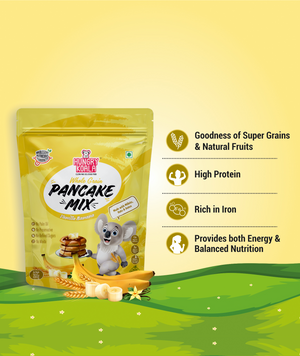
- Whole Grain Pancakes — for kids (2y+)
- Hungry Koala Wholgro SuperKids — active nutrition for kids (2y+)
- Healthy Snacks for Kids — pediatrician-approved range
- Combo deals — build a week of clean breakfasts
- Read our story — meet Dr. Sayed Mujahid Husain & Shazia Anjum